
Discovering that someone has accessed your business systems without authorization can put customer information, operations, and business continuity at risk. Knowing what to do after a data breach helps you respond methodically, limit further exposure, and make informed decisions about recovery.
A clear response plan is especially important for small businesses that may not have an in-house security team. Acting promptly matters, but so does taking the right steps in the right order. Here is how to approach a potential breach, protect affected systems, and plan the next steps.
1. Confirm the Incident and Assess the Immediate Risk
Start by reporting the suspected breach to the person responsible for IT or cybersecurity. Record what was detected, when it occurred, which systems may be affected, and any unusual activity employees observed.
Not every security alert confirms a data breach. Your IT or security team should investigate the evidence to determine whether unauthorized access occurred and identify the systems or accounts that may be involved.
Avoid deleting suspicious emails, wiping devices, or making unnecessary changes before the incident has been assessed. These actions can remove evidence that may help establish what happened and how the attacker gained access.
2. Contain the Threat Safely
Once a breach is suspected or confirmed, the next priority is to limit further access and prevent the incident from spreading. The appropriate response depends on the systems affected and whether the threat is still active.
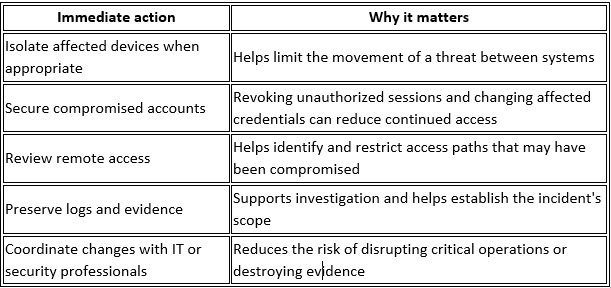
Do not automatically shut down every server, disconnect the entire business network, or reset every password without assessing the situation. Broad changes may interrupt operations or complicate an investigation. Follow a coordinated containment plan based on the available evidence.
If you suspect an active ransomware attack or ongoing unauthorized access, contact qualified IT or security professionals promptly.
3. Contact the Right People
A small business data breach response may require support from several parties, depending on the severity and nature of the incident.
· IT or cybersecurity support: Help assess affected systems, contain the threat, investigate access, and plan remediation.
· Cyber insurance provider: Review your policy and reporting requirements as early as possible. Some policies specify approved response providers or procedures that must be followed.
· Legal counsel: Help assess privacy obligations, contractual requirements, and potential liability.
· Relevant business leaders: Coordinate decisions, assign responsibilities, and maintain a clear record of actions taken.
· Specialist incident responders: Consider qualified forensic or incident response support when the scale or complexity of the incident requires it.
Not every suspected breach requires the same response team. The information exposed, the extent of unauthorized access, and the potential business impact will determine which specialists are appropriate.
4. Determine What Information Was Exposed
Understanding the scope of the incident is essential to deciding what to do next. Work with your IT or security team to establish, as far as the available evidence allows:
· Which systems, accounts, and applications were affected.
· Whether unauthorized access to sensitive information occurred.
· What categories of data may have been viewed, copied, changed, or encrypted.
· Whether customer, employee, financial, or business records were involved.
· Whether the attacker may still have access to any systems.
An investigation may not establish every detail immediately. Document what is known, what remains uncertain, and how the investigation is progressing. Avoid making definitive statements about the data involved until there is sufficient evidence.
5. Understand Notification and Reporting Obligations
After a breach, a business may have obligations to notify affected individuals, regulators, business partners, or other organizations. These requirements depend on factors such as the type of information involved, the applicable jurisdiction, the industry, and contractual commitments.
There is no single notification deadline that applies to every small business data breach. Some laws and regulatory frameworks impose specific timelines, while other requirements depend on the circumstances.
Consult qualified legal counsel to determine which rules apply, when notifications are required, and what information those notices should contain. If notification is necessary, communications should be accurate, timely, and consistent with applicable requirements.
Keep a record of key decisions, investigation findings, and communications. This documentation can help demonstrate how the business responded and support any required reporting.
6. Remove the Cause and Strengthen Security
Restoring normal operations is only part of the recovery process. Your business also needs to address the weakness that allowed the incident to occur.
Depending on the findings, remediation may include:
· Patching vulnerable software and systems.
· Removing unauthorized access and malicious software.
· Securing compromised accounts and reviewing access permissions.
· Enabling multi-factor authentication where appropriate.
· Reviewing endpoint protection and identity security controls.
· Improving email security and employee phishing awareness.
· Reviewing third-party access and connected applications.
· Strengthening monitoring and incident escalation procedures.
Security improvements should be based on the investigation rather than assumptions. If the original entry point remains unresolved, restoring systems alone may leave the business exposed to another incident.
7. Restore Operations and Verify Recovery
Recovery should follow a controlled process. Before returning affected systems to normal use, verify that the threat has been addressed and that the systems are sufficiently secure to resume operations.
If data must be restored from backups, check that the backups are suitable and have not been compromised. Test restored systems and confirm that important business applications, user access, and critical workflows function correctly.
Recovery time varies with the incident's severity, the systems involved, the availability of clean backups, and the work needed to address the underlying cause. Avoid committing to a fixed recovery timeline until the scope of the incident is understood.
Continue monitoring for suspicious activity after systems are restored. Review what happened with the relevant team, document lessons learned, and update your data breach response plan accordingly.
How BBComputing Helps Small Businesses Strengthen IT Security
Small businesses benefit from having reliable IT support and security controls in place before an incident occurs. BBComputing provides managed IT services for small businesses, typically supporting organizations with 3 to 50 employees. Based in Chicago, the company serves clients across the country.
Its services include business-hours helpdesk support from Monday through Friday, 8 a.m. to 5 p.m. Central, with after-hours escalation for urgent issues. BBComputing also provides 24/7 automated monitoring of managed devices, managed endpoint detection and response (EDR), and Microsoft 365 identity threat detection backed by a 24/7 security operations center (SOC) that investigates and responds to threats.
Security awareness training and Microsoft 365 backup are also available. These services can help businesses strengthen their security posture and prepare for technology incidents.
If your business wants to improve its IT security, review its current protections, or establish a more structured approach to managing technology risks, contact BBComputing to discuss your requirements.
Frequently Asked Questions
How quickly should a small business report a data breach?
Report a suspected incident to the appropriate IT or security contact promptly. External notification deadlines vary according to applicable laws, industry rules, contracts, and the information involved. Consult legal counsel to determine the specific obligations and timelines for your situation.
Does cyber insurance cover the cost of a data breach?
Coverage depends on the policy, exclusions, limits, and circumstances of the incident. Some policies may cover eligible investigation, legal, notification, or recovery expenses. Contact your insurer promptly, review the policy requirements, and confirm which costs and response providers are covered before assuming an expense will be reimbursed.
What commonly causes small business data breaches?
Common causes include phishing, compromised credentials, weak access controls, unpatched vulnerabilities, misconfigured systems, and malicious software. Reviewing how an incident occurred helps a business prioritize the right corrective measures.
Should a business pay a ransom after a ransomware attack?
There is no universal answer that fits every incident. Payment does not guarantee that data will be restored or that stolen information will be deleted. Consult qualified incident response professionals, legal counsel, and your insurer where applicable. Also consider any relevant legal restrictions before making a decision.
How long does it take to recover from a data breach?
Recovery can range from a relatively short disruption to an extended process involving investigation, system restoration, security improvements, and required notifications. The timeline depends on the scope of the breach, the systems affected, the availability of clean backups, and the complexity of remediation.
What should a data breach response plan include?
A useful plan identifies who must be notified internally, how incidents are reported, how affected systems are assessed and contained, how evidence is preserved, and how recovery and communications are coordinated. It should also explain how the business evaluates notification obligations and how the plan will be tested and updated.
A well-prepared plan helps small businesses respond more consistently when a security incident occurs. Reviewing security controls and response procedures before a breach can make it easier to identify risks, coordinate decisions, and restore operations responsibly.