
Cybersecurity involves more than installing security software. Businesses also need to understand how threats are detected, who investigates suspicious activity, and how
incidents are handled. Two terms that often come up in this discussion are Endpoint Detection and Response (EDR) and Managed Detection and Response (MDR).
Although both approaches support threat detection and response, they describe different aspects of cybersecurity. Understanding MDR vs EDR can help small businesses evaluate security solutions and determine which capabilities their IT environment requires.
What Is EDR and How Does It Work?
Endpoint Detection and Response (EDR) is a cybersecurity technology designed to detect, investigate, and support responses to suspicious activity on endpoint devices. These endpoints may include laptops, desktop computers, and servers.
Unlike security tools that focus primarily on identifying malicious files, EDR can collect endpoint activity data and analyze behavior that may indicate a threat. Depending on the product, it can identify suspicious processes, unusual account activity, or attempts to access sensitive information.
EDR solutions can also provide investigation tools and automated response actions. For example, a solution may isolate a potentially compromised device from the network or block a suspicious process when configured conditions are met.
However, EDR capabilities vary by product and configuration. Organizations still need a defined process for reviewing alerts, investigating incidents, and deciding what action to take. Some environments use an internal IT team, while others rely on a managed security service.
What Is MDR in Cybersecurity?
Managed Detection and Response (MDR) is a cybersecurity service that combines security technology with ongoing analysis and response from security professionals. Rather than relying entirely on a business's internal team to review alerts, an MDR provider supplies a team that monitors security information, investigates suspicious activity, and helps respond to identified threats.
MDR cybersecurity services commonly use tools such as EDR, although the specific technologies, monitoring scope, and response responsibilities depend on the provider's service.
An MDR engagement may include:
• Threat monitoring: Reviewing security alerts and activity for signs of suspicious behavior.
• Threat investigation: Examining relevant evidence to determine whether an alert indicates a potential incident.
• Threat hunting: Searching for suspicious activity that may not have triggered a clear alert.
• Incident response: Taking agreed actions to contain or address identified threats.
• Security recommendations: Providing guidance to help reduce the likelihood of similar incidents.
The exact scope of these services varies. Businesses should confirm which systems are covered, whether response actions are included, how incidents are escalated, and what responsibilities remain with their own IT team.
MDR vs EDR: What Is the Difference?The main difference between EDR and MDR is that EDR refers to a security technology, while MDR describes a managed service that combines technology with security expertise.
EDR provides visibility into endpoint activity and tools to investigate and respond to threats. MDR adds a service model in which security professionals monitor and analyze relevant alerts and perform agreed response activities.
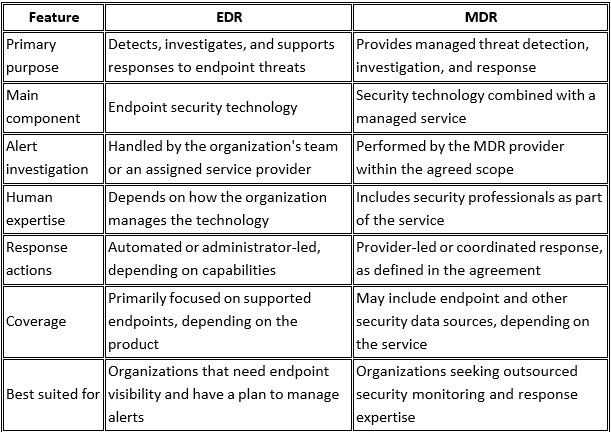
These categories can overlap. An EDR product may be supported by a managed security team, and an MDR service may use EDR as one of its core technologies. The practical difference depends on the tools, service scope, and response responsibilities included in the arrangement.
Which Solution Is Right for Your Business?Choosing between EDR and MDR depends on your existing IT resources, security requirements, and ability to investigate threats.
When EDR May Be a Suitable Choice
EDR may suit an organization that has an internal IT or security team capable of reviewing alerts, investigating suspicious behavior, and coordinating incident response.
Before selecting an EDR solution, assess whether your team has the time and expertise to manage it effectively. Installing the technology alone does not establish a complete incident response process. Alert ownership, escalation procedures, and investigation responsibilities should be clearly defined.
When MDR May Be Worth Considering
MDR may be appropriate for businesses that need dedicated security monitoring and investigation but do not have sufficient internal resources to provide those functions independently.
A managed service can give an organization access to security professionals without requiring it to build every capability in-house. However, the value depends on the provider's coverage, response procedures, and ability to work with the business's existing systems.
Before signing an agreement, ask about monitoring coverage, response authority, escalation processes, reporting, and any activities that remain the responsibility of your internal team.
What Happens When a Security Threat Is Detected?The response to a security threat depends on the technology involved, the evidence available, and the agreed security procedures.
With EDR, the software may generate an alert when it detects suspicious endpoint behavior. It may also take configured actions, such as isolating a device. An IT or security professional may then need to investigate the alert, determine the incident's scope, and coordinate remediation.
With MDR, the provider's security team investigates alerts and takes response actions within the scope of the service agreement. This may involve containing a threat, recommending remediation, or coordinating with the organization's IT team.
Neither approach guarantees that every threat will be detected or prevented. Effective incident handling depends on the quality of the security tools, monitoring coverage, available evidence, response procedures, and cooperation among the teams involved.
How BBComputing Supports Business CybersecurityBBComputing provides managed IT services for small businesses, typically organizations with 3 to 50 employees. Based in Chicago, the company supports clients across the country.
Its cybersecurity services include managed endpoint detection and response (EDR) and identity threat detection for Microsoft 365 accounts. These capabilities are backed by a 24/7 security operations center (SOC) that investigates and responds to threats. BBComputing also provides 24/7 automated monitoring of managed devices.
For day-to-day IT assistance, its helpdesk operates Monday through Friday, 8 a.m. to 5 p.m. Central, with after-hours escalation for urgent issues. Security awareness training and Microsoft 365 backup are also available.
For businesses evaluating MDR vs EDR, it is important to distinguish between the technology being used and the security service supporting it. BBComputing's managed EDR service includes SOC-backed threat investigation and response.
Businesses can contact BBComputing to discuss their current IT environment, endpoint security requirements, and Microsoft 365 protection needs.
Frequently Asked QuestionsCan MDR replace antivirus software?
Not necessarily. MDR is a managed security service, while antivirus is a type of security technology. MDR services may use EDR and other tools alongside existing antivirus or endpoint protection. The appropriate configuration depends on the products involved and the organization's security requirements.
Is EDR included in MDR services?
Many MDR services use EDR technology to collect endpoint activity and investigate threats. However, the specific tools and licenses included vary by provider. Review the service agreement to confirm which technologies and devices are covered.
Does MDR provide 24/7 security monitoring?
Many MDR services offer round-the-clock security monitoring, but coverage and response responsibilities vary. Confirm whether the service includes continuous alert monitoring, human investigation, incident escalation, and response actions, and identify any limitations in the agreement.
How quickly can MDR respond to a threat?
Response times depend on the provider's service commitments, the severity of the alert, the available evidence, and the actions required. Ask providers to explain their escalation process and any response targets rather than assuming every incident will be handled within a fixed timeframe.
Is MDR suitable for small businesses?
MDR can be a useful option for small businesses that need security expertise but lack the internal resources to manage threat monitoring and investigation independently. The right choice depends on the organization's risks, budget, existing IT support, and the scope of the proposed service.
Does EDR automatically stop every cyberattack?
No. EDR can detect suspicious behavior and may take automated response actions, but no security tool guarantees detection or prevention of every attack. Businesses should combine endpoint security with measures such as multi-factor authentication, software updates, backups, employee training, and a documented incident response process.
Make an Informed Decision About Your SecurityUnderstanding what MDR cybersecurity is and how it differs from EDR helps businesses evaluate security solutions based on more than product names. EDR provides endpoint detection and response capabilities, while MDR adds a managed service for security monitoring, investigation, and agreed response activities.
Before choosing a solution, review your existing IT resources, required coverage, incident response responsibilities, and the services included in the agreement. For small businesses that need managed IT support and SOC-backed endpoint security, BBComputing can help assess those needs and discuss suitable options.