
Antivirus software and endpoint detection and response (EDR) help businesses protect their computers from cybersecurity threats, but they work in different ways. Traditional antivirus focuses primarily on identifying and blocking malicious files, while EDR provides broader visibility into endpoint activity to help detect, investigate, and respond to suspicious behavior.
Understanding antivirus vs EDR helps small business owners evaluate whether their existing security tools meet their needs. The right approach depends on the devices you use, the information you protect, and how your business identifies and handles potential threats.
What Is Traditional Antivirus Software?
Traditional antivirus software is designed to detect, block, and remove malicious software, including viruses, spyware, and other forms of malware. Many modern antivirus products also use cloud intelligence, reputation checks, and behavioral detection, so their capabilities extend beyond matching files against a list of known threats.
Antivirus tools commonly scan files when they are opened, downloaded, or executed. Depending on the product, they may also monitor system activity, quarantine suspicious files, and prevent known malicious programs from running.
For small businesses, antivirus is an important security layer. However, the capabilities vary between products, and antivirus alone may not provide the detailed investigation and response capabilities needed to understand more complex incidents.
How Does Antivirus Work?
Antivirus software uses a combination of detection methods to identify potential threats. These may include:
· Signature-based detection: Compares files with known malware patterns.
· Heuristic analysis: Examines file characteristics that may indicate malicious behavior.
· Behavioral detection: Looks for suspicious actions that may suggest a threat.
· Cloud-based intelligence: Uses updated threat information to help identify malicious files and activity.
When a threat is detected, the software may block execution, quarantine the file, or alert the user or administrator. The available actions depend on the product and its configuration.
Although modern antivirus software can detect many threats, some incidents require more context. For example, a compromised account may be used to access legitimate applications, or an attacker may attempt to move between devices using tools that are already present in the environment. These situations can require additional monitoring and investigation beyond file detection.
What Is EDR (Endpoint Detection and Response)?
Endpoint detection and response is a security technology that collects and analyzes activity from supported endpoints, such as business computers and servers. It helps security teams identify suspicious behavior, investigate potential incidents, and take appropriate response actions.
Unlike tools focused primarily on detecting malicious files, EDR can provide a broader view of activity on an endpoint. Depending on the platform, this may include process execution, changes to files, unusual connections, and other activity associated with a possible attack.
EDR capabilities may include:
· Monitoring endpoint activity for suspicious behavior.
· Generating alerts about potential security incidents.
· Providing investigation details to help determine what happened.
· Supporting response actions, such as isolating a device from the network.
· Helping security teams trace activity and assess the scope of a threat.
EDR does not guarantee that every attack will be detected or stopped. Its effectiveness depends on the product, configuration, available telemetry, and how alerts are investigated and handled.
Why Do Organizations Need EDR Cybersecurity?
Businesses increasingly rely on cloud applications, remote access, and connected devices. This creates more opportunities for attackers to exploit compromised credentials, malicious downloads, software vulnerabilities, or other weaknesses.
EDR cybersecurity can help organizations investigate suspicious endpoint activity that may not be adequately explained by a basic malware alert alone. For example, if an application begins making unusual changes or a process behaves unexpectedly, EDR may provide evidence that helps a security team assess whether the activity is malicious.
EDR can be particularly useful for businesses that need better visibility into endpoint threats and a structured way to investigate security alerts. However, it is one component of a broader security strategy. Strong authentication, timely software updates, secure backups, employee awareness, and appropriate access controls remain important.
EDR vs. Antivirus: Side-by-Side Comparison
Although antivirus and EDR can overlap in their detection capabilities, their primary roles differ.
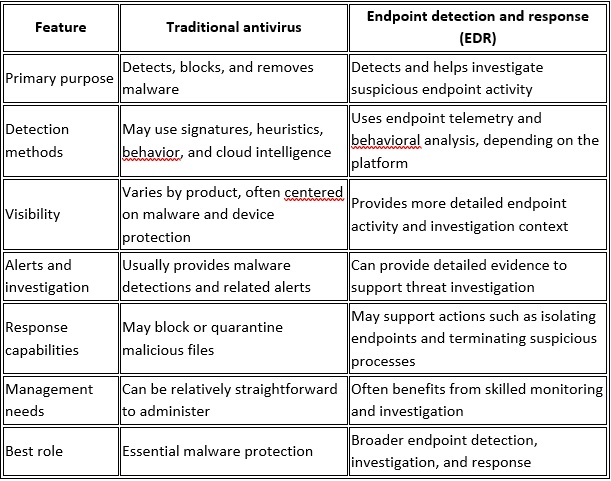
The comparison is not an absolute division. Modern antivirus products may include advanced behavioral features, while EDR products vary in their detection and response capabilities. Businesses should compare the features of specific products rather than relying on the category name alone.
How Endpoint Detection and Response vs. Antivirus Fits Your Business
Choosing between endpoint detection and response vs antivirus depends on your current security setup, the sensitivity of your business data, and the resources available to manage threats.
When Antivirus May Be Sufficient as a Starting Point
Antivirus can be an appropriate starting layer for a small business that needs basic malware protection. It should be kept updated and configured correctly, with alerts reviewed and other essential security controls in place.
However, a business should not assume that antivirus alone provides all the visibility, investigation, or response capabilities it may need.
When EDR May Be the Better Fit
EDR may be appropriate when a business needs more detailed visibility into endpoint activity, better investigation capabilities, or support for responding to suspicious behavior.
Organizations should consider who will review alerts, investigate incidents, and take response actions. Buying an EDR product does not automatically mean that a security team is actively monitoring and responding to every alert.
Should a Business Use Both?
Antivirus and EDR are not necessarily competing choices. Depending on the product, EDR may incorporate antivirus capabilities, work alongside existing endpoint protection, or form part of a broader security platform.
Before replacing an existing tool, confirm whether the proposed EDR product includes the required malware protection, how the products interact, and whether the configuration meets your security requirements.
A layered approach that combines suitable endpoint protection with identity security, employee training, backup, and monitoring can provide more comprehensive coverage than relying on a single tool.
How BBComputing Helps Businesses Strengthen Endpoint Security
BBComputing provides managed IT services for small businesses, typically supporting organizations with 3 to 50 employees. Based in Chicago, the company serves clients across the country.
Its services include managed endpoint detection and response (EDR) and Microsoft 365 identity threat detection, backed by a 24/7 security operations center (SOC) that investigates and responds to threats. BBComputing also provides 24/7 automated monitoring of managed devices, along with helpdesk support Monday through Friday, 8 a.m. to 5 p.m. Central, and after-hours escalation for urgent issues.
Security awareness training and Microsoft 365 backup are also available. These capabilities can form part of a broader approach to managing business technology and reducing security risks.
If your business is reviewing its endpoint protection or needs help understanding its current IT security setup, contact BBComputing to discuss your requirements and the services that may be appropriate for your environment.
Frequently Asked Questions
What is the main difference between antivirus and EDR?
Antivirus focuses on detecting, blocking, and removing malware. EDR provides additional endpoint activity visibility and tools to investigate suspicious behavior and respond to potential incidents. Modern products can overlap, so compare their actual features.
Can EDR replace traditional antivirus completely?
Some EDR products include antivirus or other prevention capabilities, while others may work alongside separate endpoint protection. Confirm which protections are included before replacing existing software. EDR should not be assumed to provide every security feature a business needs.
Is EDR harder to manage than regular antivirus?
EDR can produce more detailed alerts and investigation data, which may require additional security expertise. The level of effort depends on the product, the environment, and whether monitoring and response are handled internally or through a managed security service.
Why might traditional antivirus not be enough for a business?
Antivirus remains an important defense, but a business may also need deeper visibility into endpoint activity, investigation tools, identity protection, and coordinated incident response. Whether additional controls are necessary depends on the organization's risks and existing security capabilities.
Does EDR protect remote devices outside the office network?
Many EDR platforms can monitor supported devices when they are away from the office, provided the required software, connectivity, and configuration are in place. Confirm the product's remote-device capabilities and how alerts are handled when employees work remotely.
Does having EDR mean someone is monitoring threats 24/7?
Not necessarily. EDR is a technology, and monitoring arrangements depend on the service and provider. Some solutions are managed internally during set hours, while others are backed by a security operations center that operates around the clock. Businesses should confirm the monitoring and response arrangements included in their service.
Antivirus and EDR serve important but distinct roles in endpoint security. Understanding their capabilities helps small businesses choose protection that fits their risks, resources, and operational needs while ensuring that alerts can be investigated and addressed appropriately.